Blue Fern Adventures

Our second four weeks in Norway

Our second month in Norway was even more awe-inspiring than the first. After meeting with Linda and Steven from The Chouters, we continued north on the Kystriksveien (Coastal Highway/FV 17) coastal route. This is a 630km scenic route which is more beautiful but slower than the E6 highway: there are six ferry crossings on the main route and many more possible crossings to additional islands.

Arctic_Circle

As we headed north along the route, we began to cross incredible lunar landscapes and, on a ferry, we entered the Arctic Circle (and brought out our Cayman Islands flag). Linda and Steven recommended a wild camping site that overlooked Svartisen Glacier and Amelia picked wild blueberries and raspberries. We also saw the Saltstraumen maelstrom, where some of the world’s strongest tidal currents form whirlpools when the tide rushes in and out of the fjord.

We parked by a beach just outside Bodø. Soon other motorhomes arrived and Amelia met some French children and played with them in the golden evening light. While the kids played, the parents told us about their experiences in the Lofoten Islands, particularly the Reinebringen hike, and we shared Vin de Noix (fortified walnut wine) and Vin de Sureau (fortified elderflower wine) that we made in France. We also chatted with a couple from the Netherlands who also had a Weinberg motorhome. Amelia became interested in spotting license plates during our travels and mentioned to them that she had noticed their “NL” license plates. We were touched when they left us a bag of treats and a sweet note from the “NL Weinsberg” before driving off early the next morning.
Reinebringen

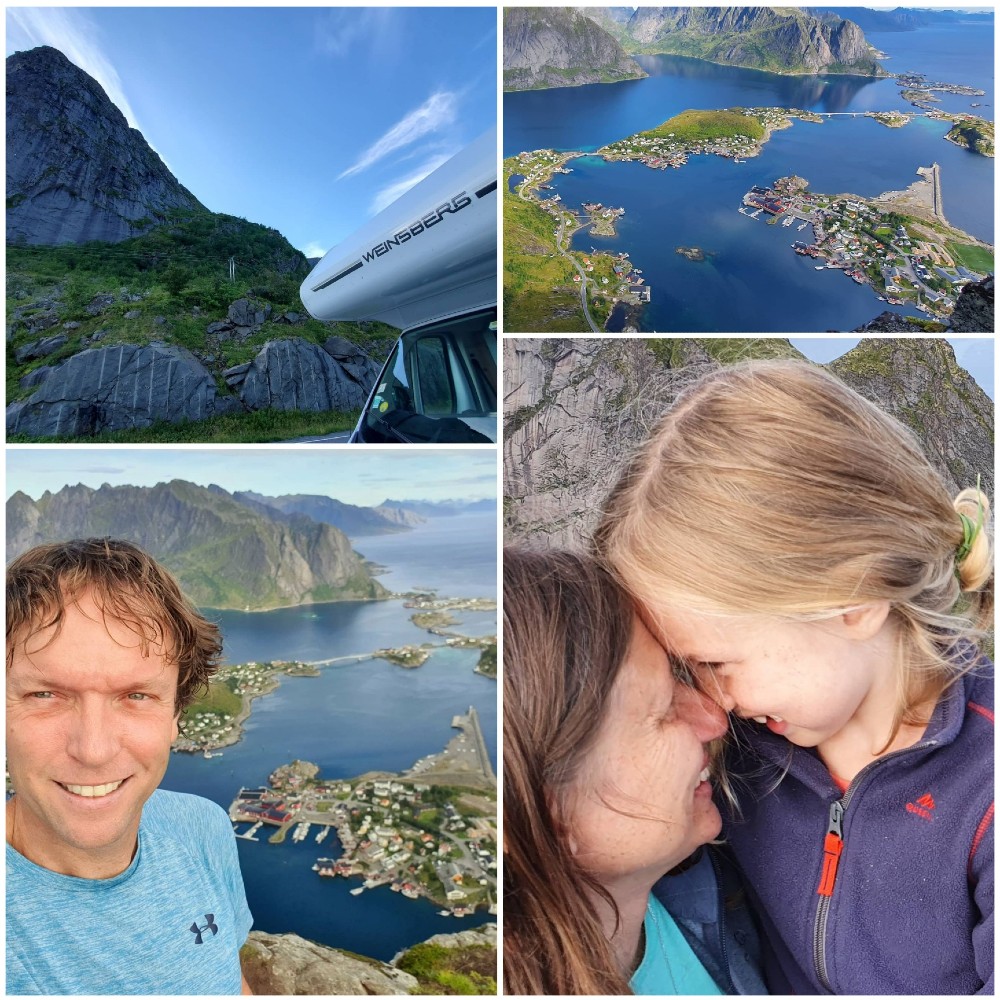
The next day, we drove into Bodø where it is possible to catch a ferry to the Lofoten Islands. There was a forecast for sunny weather the next morning, followed by a week of rain, so we decided to catch a night ferry to Moskenes, near the western tip of the Lofoten Islands. It was our roughest ferry crossing yet and we were glad to see an incredible wall of jagged mountains as we approached the islands in the twilight. We drove to the town of “Å” a few miles away and stayed in a parking lot which was filled with motorhomes from all over Europe. The next day, we woke up early and set off to hike Reinebringen while it was still sunny. It was a difficult hike up 1,560 steps but the views from the top were truly spectacular. We felt as if we had stepped into one of computer screen saver photos that had tempted us before we had even started our travels.

Next, we stopped in the town of Reine and found it very touristy – even late in the summer and in a Covid year with no cruise ships or tour buses. A cold rain began to fall the next day so we took the opportunity to visit a glassblowing shop that had been recommended by our friends at Frenchy Le Van – it was a perfect day to watch amazing glass blowing demonstrations by a roaring furnace.

Birthday_Campsite

We then began driving back through the chain of islands toward the mainland, following recommendations from the wonderfully comprehensive Motoroamers blog – they even have an eBook on the Lofoten  Islands. We found the islands to be much less busy once we left Reine and particularly enjoyed the 815 route – a quiet road with spectacular granite boulders and spiky mountains. Next, we drove through Andoya and took an evening ferry to Senya – following even more scenic routes. We did not find these islands to be quite as stunning as the Lofoten Islands (almost an impossible act to follow) but if the Lofoten Islands were too busy we thought they would be preferable! We agreed that we loved the lack of crowds and the sense of discovery and exploration that we found in Norway; the popular places are popular for a reason but many areas that are off the beaten track are just as spectacular. Too soon, it was time to head south. We found a small friendly campsite and settled in for a couple of days to celebrate Gary’s birthday – including his first ‘polar plunge’ within the Arctic Circle.

Given that the Kystriksveien which we took on the way north is a scenic route and the E6 is an inland highway, we had low expectations for the drive south. However, the northern portion of the E6 was surprisingly scenic. We would still pick the coastal highway if we were only driving one way in Norway but we enjoyed seeing granite domes, fjords, forest, and high plateau – including reindeer by the Arctic Circle Centre and musk ox habitat near Hjerkin.

Morning_Mist

On our way to the Lofoten Islands, we took a route near the coast and missed several highly recommended scenic routes and sites, planning to see them on our way south. First, we visited Briksdalbreen Glacier. The surrounding area is also spectacular, with rivers and lakes coloured a shocking blue by ‘rock flour’ – rocks which have been pulverized to dust by the movement of the glacier and which are suspended in the water. We then drove more incredible scenic routes, including Trollstigen (a dramatic mountain road with a 10% grade and eleven hairpin bends), Dalsnibba Utsiktspunkt (literally jaw-dropping scenery which we viewed through gaps in the mist), Gamle Strynefjellsveg (landscapes from another planet with guard stones lining the road like teeth), and the Flåm scenic route (where we were fortunate to see flaming autumn foliage reflected in the dark water).

We left Norway by way of Moss, near Oslo, where we visited Gary’s old friends Bernhard and Olaug – spending some wonderful time together and joining them for a typically Norwegian taco dinner . It was sad to say goodbye to Bernhard and Olaug and leave Norway after two months of wonderful travels but at the same time we were excited to enter our next country: Sweden, where Amelia was looking forward to trying banana pizza – you’ll find her review in our next blog 😊

Practicalities of Travelling in Norway:

Because of the uncertainty of travel during COVID-19, we did very little itinerary planning before we arrived in Norway. We were lucky to find some extremely helpful and comprehensive motorhome blogs to help us get up to speed…e.g.

Motoroamers

OurTour Motorhome Blog

Wandering Bird

The Gap Decaders

We also met Linda and Steven from The Chouters & Bijou while we were in Norway and loved reading their very funny and beautifully-illustrated blogs while they travelled south and we travelled north.

You can read our Norway itineraries here:

And we have added a few other notes below:

  1. AutoPASS: be sure to order an electronic tag for both AutoPass and AutoPASS Ferry when you are starting to plan your trip so that you can have the tag mailed to you. If this isn’t possible, you can still register online: normally, you will still benefit from the AutoPASS discount when your license plate is scanned.
  2. When to visit: we arrived at the middle of July and left at the middle of September – perfect for outside activities, hiking and picking berries. We felt lucky to stay for the beginning of autumn: attractions were quieter in late August (after Norwegian schools re-opened) and in September, trees were turning orange and red near Flåm. Spring would be an interesting time to visit to see rushing waterfalls, the last of the snow, and the arrival of thousands of puffins, though road conditions and hikes could be more challenging. In winter, there are opportunities for skiing, visiting ice caves, and seeing the northern lights. 
  3. Tourist Offices: we found excellent informational materials (including a booklet/magazine for each region) in the various tourism offices along our route.  A number of the offices offered free Wi-Fi.
  4. Scenic routes: early in our trip, we picked up a booklet on the stunning Norwegian Scenic Routes. We then prioritized these drives and travelled 14 of the 18 routes: see our itinerary posts above. The scenery is literally jaw-dropping while driving and we snapped hundreds of pictures out the window but you cannot truly appreciate the scale, the colours, and the sensations until you are outside your vehicle. We recommended getting out as often as possible, whether it is to hike or just to stand by the road soaking in the smell of salt or seaweed from the fjords, the sound of bells on wandering sheep, the colour of the fjords or the size of the mountains.
  5. Groceries: we brought a lot of food with us that we had purchased at a discount store in Germany and found that we were able to buy anything else we needed in Norwegian groceries stores ( for a description of the various stores see this post from Life in Norway). Generally we shopped at Coop (in their larger “Extra” or “Mega” stores) or Kiwi. Bunnpris and REMA 1000 are discount stores but we didn’t always find the prices low enough to justify the more limited selection.
  6. Food: popular snack foods include hotdogs, svele pancakes (folded in half to make a sandwich with brown cheese and butter or butter and sugar; often served on ferries), waffles, and tacos (a Friday-night favourite; we love tacos and we were happy to be able to buy taco ingredients – though only ‘Old El Paso’ style brands). In addition, we also enjoyed eating salmon and wild berries, and apples and plums from the many orchards on the side of the fjords. We snacked on spring rolls and churros while exploring Trondheim but otherwise we didn’t eat out in Norway.
  7. Where to stay: we found this link to be a helpful summary of rules for parking (vs camping) in Norway. We used Park4Night and spent most of our nights wild camping. It is also possible to find your own sites. Marinas are also a good option for paid sites with facilities; many campsites seemed crowded and expensive but we enjoyed staying at Oldevatn Camping which offered free boats to explore a glacial lake.
  8. Diesel prices: Diesel pricing baffled us (and a lot of other motorhomers too).  We drove past one station in the morning and the price was NOK14.49/litre and when we drove past again after lunch it was NOK17.49/litre (50 litres would be €15 more expensive!)  From what we could gather, diesel prices are generally cheapest on Sundays and first thing on Monday mornings. 
  9. Propane: It is true that LPG/GPL is not as widely available as in countries such as France but we found that we would drive past a pump twice a week.  We would fill up when we could instead of when we needed to.  It also appeared that filling ‘foreign’ gas bottles was possible. Both Park4Night and MyLPG helped us find filling stations.
  10. Dumping/water etc: there are many options on Park4Night.
  11. Laundry: we only found laundry facilities at campsites and marinas. Some will let you use the facilities without an overnight stay.
  12. KID bank account: There were 2 occasions when we needed to make a wire transfer (to pay AutoPASS until we changed to charging a credit card and to pay a parking ticket).  Both times the SWIFT payment/wire failed.  It appears that this happened because a KID (“kundeidentifikasjon” or customer identification) is needed.  You need to request the details of the bank account for non-KID payments.
  13. Internet: Norway has excellent cell phone coverage so it is easiest to use data rather than depending on campsite Wi-Fi (often poor signal strength) or free Wi-Fi. If you are looking for free Wi-Fi, grocery stores, gas stations, and tourist offices seemed to be the best places to check.
  14. Public bathrooms: abundant and very clean. Many had stunning views or were uniquely designed.
  15. Swimming pools: due to cool weather when we visited, the warm indoor public swimming pools were a highlight for our daughter. She loved them so much that we visited about one pool per week. Depending on the size of the facility, they may have waterslides, diving boards, climbing walls, and even whirlpools and wave pools. These are public pools not luxury spas, but for adults, there may be designated lanes for lap swimming, jacuzzis, steam rooms, and saunas. Two favourites: Lustrabadet and Atlanterhaven but the smaller pools (in nearly every large town) are also fun and generally less expensive.  
  16. Hiking: we did some amazing hiking in Norway, including the extremely popular hikes of Preikestolen/Pulpit Rock and Reinebringen. If you search for “hikes in Norway” you will see many challenging 10 to 12 hour hikes but during our trip we naturally came across many easier family-friendly opportunities e.g. a short walks to Briksdalsbreen Glacier and Torghatten.

Our favourites in Norway:

First of all, the incredible scenery. The fjord region was how we imagined Norway – but more spectacular – and we were surprised by the variety of the landscapes even within this region. The inner fjords, far from the sea, are classic ‘fjordland’ with dramatic views around every bend in the road. We especially loved seeing the different coloured water – ranging from ice-blue glacier melt to dark black reflecting the autumn leaves. The outer fjords, near the ocean, are lower – but they have incredible sea cliffs (such as Hornalen) and bird islands (such as Runde). The “top” Norway places truly are stunning: Preikestolen, Lofoten islands, Geiranger fjord, Trollstigen, and Flåm scenic lookout. We were lucky to see them in an unusual year when they were not too busy. Otherwise, they would be best off season or there are many other uncrowded and spectacular areas to explore. Some of our other favourites: amazing wild camping; hiking – particularly Reinebringen; picking wild blueberries and raspberries in the forests and along the edges of the fjords; glacial rivers and lakes; fjord horses; wild reindeer near the Arctic Circle Centre; drinks on a floating dock in Trondheim; and swimming in the fjords, including a “polar plunge” in the Arctic Circle.

And Amelia loved the swimming pools and making friends with other children at wild camps and campsites.

We couldn’t possibly recommend a Norway road-trip more highly.

Our first four weeks in Norway

WOW!   Norway is impressive.  In The Hitchhiker’s Guide to the Galaxy, Slartibartfast, designer of planets, wins an award for the Norwegian fjords.  We know now that the award was well-deserved.

Janice was impressed by the scenery between Kristiansand and Stavanger; Gary, who visited Stavanger 24 years ago, knew the coast would become more spectacular as we travelled north.

Gary re-lived parts of his visit to Stavanger by suggesting we drive down to Lysebotn (at the end of Lysefjord) and then catch the ferry to Forsund. We drove through a lunar landscape at the end of the fjord, and then viewed its vertical nearly 1,000m (3,300′) granite walls from the bottom, during the ferry crossing, and from the top at Preikestolen (“Pulpit Rock”).  The hike to Preikistolen is challenging (8 km/5 miles in total with a climb of 300m/1,000’). Amelia made a friend the night before our hike and was thrilled to meet her at the top. It took us 2 hours and 20 minutes to hike up and then we spent the whole day at Pulpit rock and glacial lakes along the path with Amelia’s friend and her family. Amelia rated the experience 10/10 (a high score usually only achieved by water parks) and she has been enthusiastic about other hikes – especially if their completion is celebrated with expensive Norwegian ice cream!

At a tourist office, we picked up a brochure for “Fjord Norway” which stretches from Stavanger to Ålesund. Even though we usually travel slowly, and we only have a period of 90 days in the Schengen zone, we decided to head north through the fjords to Ålesund. Then, when we reached Ålesund, we decided to continue to Kristiansund – and then the Lofoten Islands.

Gaularfjellet-Utsikten

Norway has a number of National Scenic Routes, which we have followed as we have driven north. Our favourite routes have included the magnificent mountains and glacial lake Røldalsvatnet, Hardangerfjord (covered in orchards), the bleak, windswept Hardangervidda plateau, driving up to Gaularfjellet Utsikten from Balestrand, road 776 from Høylandet, and the Kystriksveien route (Fv17, Coastal Route), especially the island of Leka, Torghatten (hole in the mountain), and the Svartisen Glacier. We still have Trollstigen and Geirangerfjord ahead of us, as we plan to see them as we head south.

Tunnel

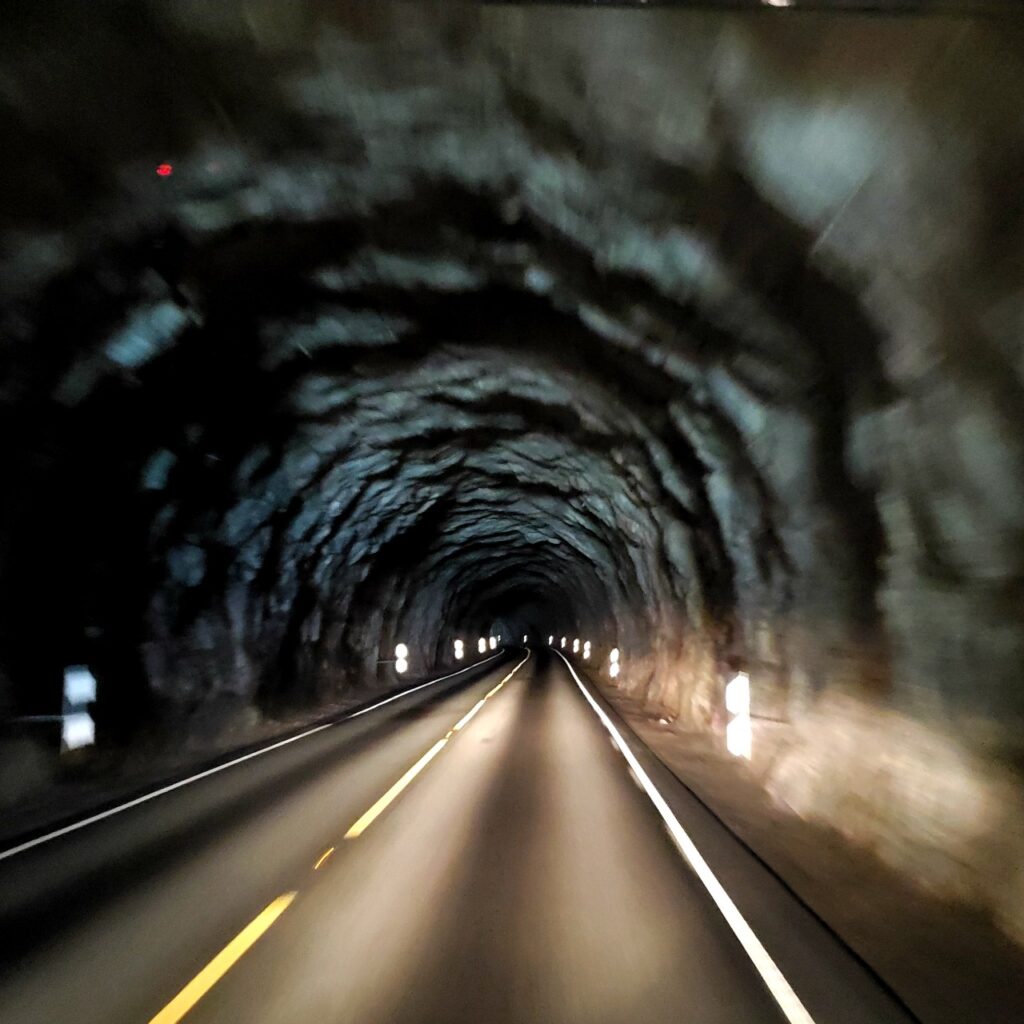
The mountains make for narrow, twisty roads with lots of tunnels – they are often dark, and the walls are unsurfaced as they have been hacked through solid granite. Gary guessed we had driven through 100 kilometres (60 miles) of tunnels but then as he thought about it, he figured that we often drive through 10km of tunnels a day, so we have easily driven through 200km (120 miles) of tunnels in these four weeks! A couple of tunnels completed 360° turns inside the mountains and the most amazing so far was the tunnel near Eidefjord with a roundabout in the middle!

Polar-Plunge

Norway is a paradise for wild camping. Lay-byes next to a fjord or lake, picnic areas, and visitor centre parking areas are often available. It took a couple of nights to get used to this new (to us) way of camping but now we are quite happy parked next to a quiet road with an amazing, always-changing view. From our overnight parkings we have seen dolphins, glaciers, sea cliffs, farms, forests, ferry docks, and harbours and we have barbequed, had beach bonfires, and even done a ‘polar plunge’ into a fjord.

Summertime is berry time and we have collected our share of wild blueberries and raspberries. Amelia has fallen in love with cooking after watching “Cook with Amber”. She suggested making parfaits and frozen yogurt bark with wild berries and some of her other favourite Amber recipes for the trip have included peanut butter energy balls, guacamole, carrot pitas, salmon sushi hand rolls, and rice balls.

Some of Amelia’s other favourites have been the heated swimming pools which also have water slides. She also enjoyed visiting the island of Leka and investigating the mystery of little Svanhild, who as a 3 ½-year-old in 1932, was apparently taken from a coastal farm by a sea eagle. She was found 7 hours later, mostly unharmed, on an inaccessible ledge in the mountains below a sea eagle’s nest. Ornithologists still question whether a sea eagle could carry her weight but, having seen the location of the ledge where she was found, it is difficult to imagine any other explanation.

A pleasant surprise was meeting up with motorhomers Linda and Steven; they used the same dealership as us to buy their motorhome and have been travelling in Europe for the past 2+ years. When we contacted them after reading a post on their blog about Norway, we were just 10km apart. They were heading south and we were heading north but we were able to meet for a quick coffee in Brønnøysund.

Originally, we had planned to spend about four weeks in Norway. Well, we have been here four weeks and we are still heading north. The scenery is so amazing that we are compelled to see what is in the next valley.

We have an idea of where we might turn around and head south but who knows? What will the next 4 weeks bring us?

Read Part II of our summer trip here

We pay a flying visit to Belgium, Netherlands, Germany, and Denmark

Our goal was to reach Norway without being caught by any border closures or lockdowns (four lockdowns is enough for now) so we rushed north from France. Along the way, we had just a taste of Belgium, the Netherlands, Germany, and Denmark.

While we love France, it was exciting to cross the border from France to Belgium and feel that we were on the move at last. We settled in a small paid parking lot by a canal (goodbye to abundant free aires and France Passion sites) and immediately discovered a large park and playground, equipped with water pumps and channels for kids to play with. For dinner, we stopped at a frituur for Belgian beers and piles of frites with ketchup and mayo. The next morning, we went to a bakery and tried a new pastry – it was a hardy dough wrapped around a spiced whole apple – a new favourite.  We prefer to drive just 1.5 hours per day (with some days of no driving) but to make our way north we had some longer days. We enjoyed refuelling with delicious Belgian chocolate on long drives.

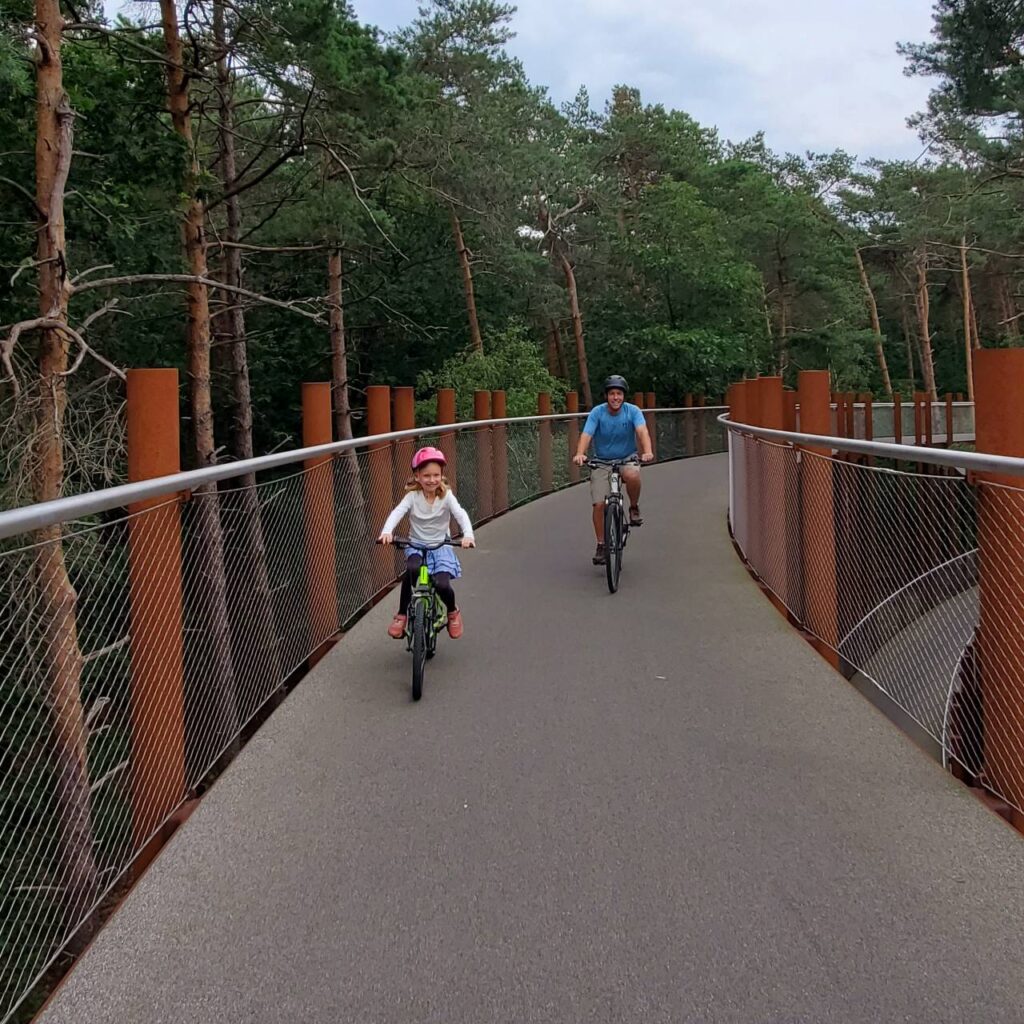
Cycling through the trees

We visited two interesting cycling attractions in Belgium – Cycling through Water in Bokrijk and Cycle through the Trees in Bosland. The first is a path through a lake that puts cyclists at eye-level with the water; the second is a circling ramp rising up through the treetops. Gary crashed off his bike but fortunately his helmet absorbed the shock of his fall, and aside from a few scrapes and bruises he was OK to keep going.  

Waffle in Ghent

Next stop, Ghent; thank you to friends for the recommendation. We stayed in a campsite near a lake; Amelia managed many hours of playground time with a new friend (an English-speaking seven-year-old with a birthday the day after hers) plus a morning swim (polar plunge style! – she is still our Caribbean baby). Despite cold rain which chased us home early, we enjoyed the historic centre of the city, with its twin cathedrals and bell tower, and a €10 strawberry and cream waffle from a street stand that didn’t have prices on the menu! But Amelia’s bucket list was complete with “waffles and fries” (from a song she learned at school in Cayman).

Maesland

We then crossed the border into the Netherlands. We had asked where it was possible to see windmills and were told “everywhere”, which was definitely true – old-fashioned wooden windmills and modern wind turbines dotted the landscape. We also cycled along the impressive Oosterscheldekering storm surge barrier and spent the night parked the Hoek van Holland (right along the Rotterdam harbour canal with enormous ships passing just outside the window). Guess what – another playground, this time with a zipline – and we counted almost 40 swans in the river! We also made a quick stop at De Maeslantkering and had a tour of the site. Our final night was spent in a grassy field by a canal. Amazing to see so much land that would be underwater (the lowest point in the Netherlands is seven metres below sea level!) if not for incredible feats of engineering and lots of drainage ditches. It felt a bit dystopian considering climate change – and just after we left, Belgium, Netherlands, and Germany were hit by tragic floods.

It was raining when we entered Germany. We stopped at a Lidl for groceries and to stock up on pantry items for Norway, where we had heard that groceries would be more expensive. Wanting a hardy hot meal, we cooked Spaetzle and sausage back at the motorhome. We planned to get a new sim card (which would work in Germany and Scandinavia) but could not get it working; this reminded us of all the problems we had when we arrived in France. We decided to increase the (international) data limit on our French sim card but will be somewhat limited on data.

Big ship

The next day, the weather cleared and we passed many fruit stands; we loaded up on strawberries and cherries. That night, we stopped on a canal near Hamburg. The area had been recommended by our friends John and Kellie; the exact site where they had stayed was full, but we found another one close by with a large playground on one side and a collection of food trucks/stands on the other. We bought a sausage and fries and potato pancakes to share, along with salad (made by Amelia) and fruit from the motorhome, and ate on the sea wall while watching the passing ships.

For each border crossing, we prepared a stack of passports and documents but we were not stopped until we reached Denmark. After a few checks and questions, we were waved across.

Finally, it felt like we had reached the north; we enjoyed the golden afternoon light and pretty fields dotted with flowers. We stayed in a motorhome site with horses and an extremely friendly cat that Amelia nicknamed Mr. Cuddles.

Legoland

The next day we cycled to Legoland – the busiest place we have been in the past 1.5 years but a lifelong dream for the Redferns 😊 And it was all very well organized and not crowded. We enjoyed the miniature cities and water rides (as there were only very short lines, Amelia was able to ride her favourites as many times as she wanted). She also went on her first roller coaster ride (and then did it 2 more times). And she met some lovely princesses who chatted with us about our travels.

The next morning, we stopped at a bakery for bread, and on impulse, Gary picked up a couple of custard pastries. He mentioned something about “Danish Pastries”, which Janice said she had never heard of – then “Wait, these are Danishes?” (they certainly seemed to be). We have not yet learned if they are more Danish than, for example, “French Toast” is French.

We anxiously checked the news many times on our trip north; we wanted to balance having reasonable driving days and seeing a little bit of the countries we were travelling through with the risk of possibly missing out on Norway if restrictions changed. On Saturday, it was announced that France was set to go on Norway’s red list on Monday – one day after our scheduled ferry departure. While we were vaccinated and could still enter from a red country, it appeared that Amelia would have to quarantine and we weren’t sure of the rules for her entry.

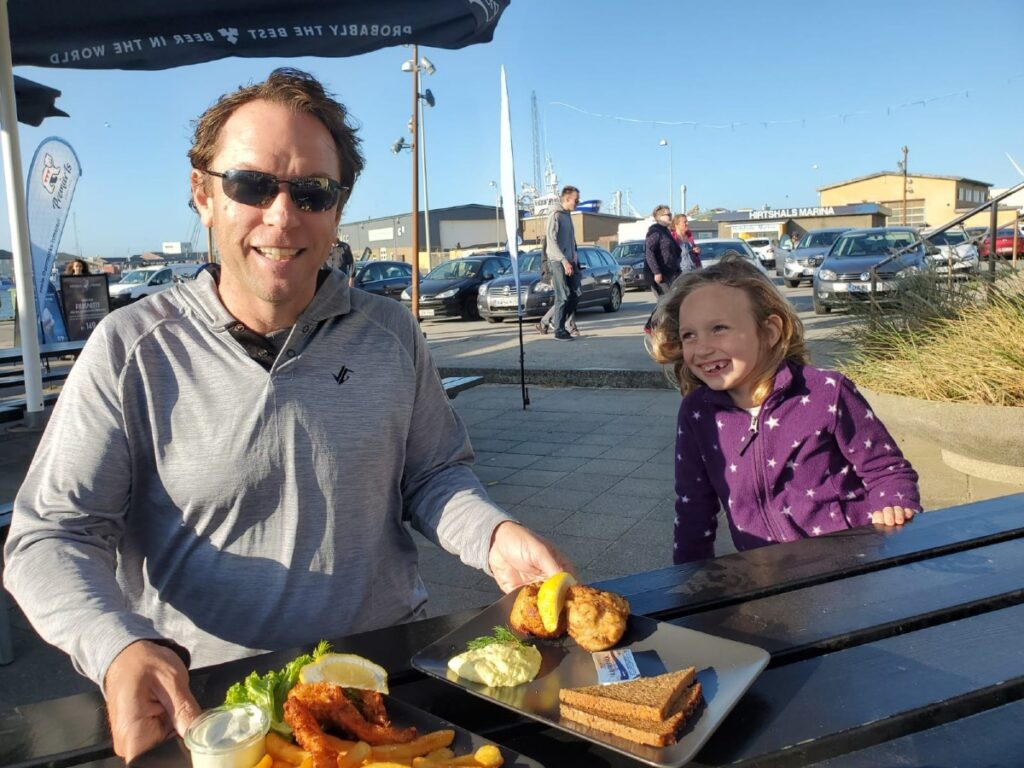
Fish and Chips

For our final night in Denmark, we drove to Hirtshals, which felt like the end of the world. We were glad to stop and have a cosy cup of tea (and a strawberry smoothie for Amelia) in the motorhome without going outside. Sand was blowing so hard in the wind that we couldn’t approach the beach, but in the evening, we walked down to the harbour and ate delicious fish and chips and fish cakes. The next morning, we woke up at 5 am because it was already so bright. The motorhome was rocking so much in the wind that Janice felt a bit ‘seasick’. We were worried our ferry being cancelled but as it got later, we saw people going to the beach in bathrobes (to swim?) and walking small dogs, so we realised that the wind must be nothing out of the ordinary.

We were extremely nervous about missing the ferry to Norway on the last day that we might be allowed to enter, but everything went smoothly (except for the rocking of the boat; there were many seasick passengers). Janice immediately stopped feeling motion sick when we were actually on the water; Gary and Amelia felt a bit queasy so spent the crossing on deck while Janice caught up on some internet time – researching Norway, which we had not been able to do previously. Thanks to some very comprehensive motorhome blogs we quickly picked up some important tips (e.g., duty on alcohol, priority right driving, no potatoes!) and some ideas for our itinerary.

And then – we arrived in Norway. Amelia had a covid antigen test at the ferry port (which she said was much better than the long swab for a PCR test) and we were on our way.

So, waffles and fries, chocolate, dikes, windmills, sausages, shipping, greenhouses, LegoLand, fried fish – just a flying glimpse so we will have to go back one day.

An amazing trip to the south-east of France

We had only planned to spend a couple of weeks in France but delays with getting our licence plates and then the late autumn lockdown resulted in us spending far longer in the country. Two upsides are that we’ve made some truly wonderful friends and we’ve come to realise that the country has so much to offer in terms of variety, be it wines (of course!), but also scenery, wildlife, history, etc., etc.

In July, we are hoping to head towards Scandinavia so before the summer heat and crowds arrived in France we decided to head south towards Carcassonne and the Mediterranean coast. Three years ago, we made a whistle stop tour along the French Pyrenees in a campervan and loved the area. The idea of our ‘big trip’ was already forming and we wanted to see if we could live in a campervan; within a couple of days, we had decided that a van would be too small.

Château de Quéribus

Before we headed back to the area, fellow motorhomers and new friends, John and Kellie, suggested we visit Quéribus and Peyrepertuse, two Cathar castles in the southwest of France. Catharism was a religious movement between the 12th and 14th centuries; its followers were ultimately annihilated by the Catholic Church after many bloody battles and sieges centred in Pays Cathare (Cathar country). The drive to the parking area at Château de Quéribus was a winding “first gear up/first gear down” road but the views from the top were absolutely stunning. The château was first mentioned in 1020 and was one of the “Five Sons of Carcassonne”: five castles strategically placed to defend the French border against Spain. We were amazed at the effort needed to build a stone castle on the high peak. We also spent a night in the aire in Duilhac-sous-Peyrepertuse with views of Château de Peyrepertuse. We didn’t visit the castle this time as the access road was too narrow for the motorhome but we would love to go back. While exploring Duilhac, we came across the Fontaine des Amours with a verse from Ronsard (a 16th-century poet) inscribed above the fountain. It stated that whoever drinks from the fountain will fall in love – and though we recently celebrated our ninth wedding anniversary we thought it couldn’t hurt to take a sip!

Before the trip, we had also made contact with a couple of home-/world-schooling families and planned a route that would allow Amelia to meet some other English-speaking children for outdoor playdates. She had an amazing time with a new friend in the small town of Caunes-Minervois splashing through a small stream while the parents sipped coffee at an outside café – our first time since September!

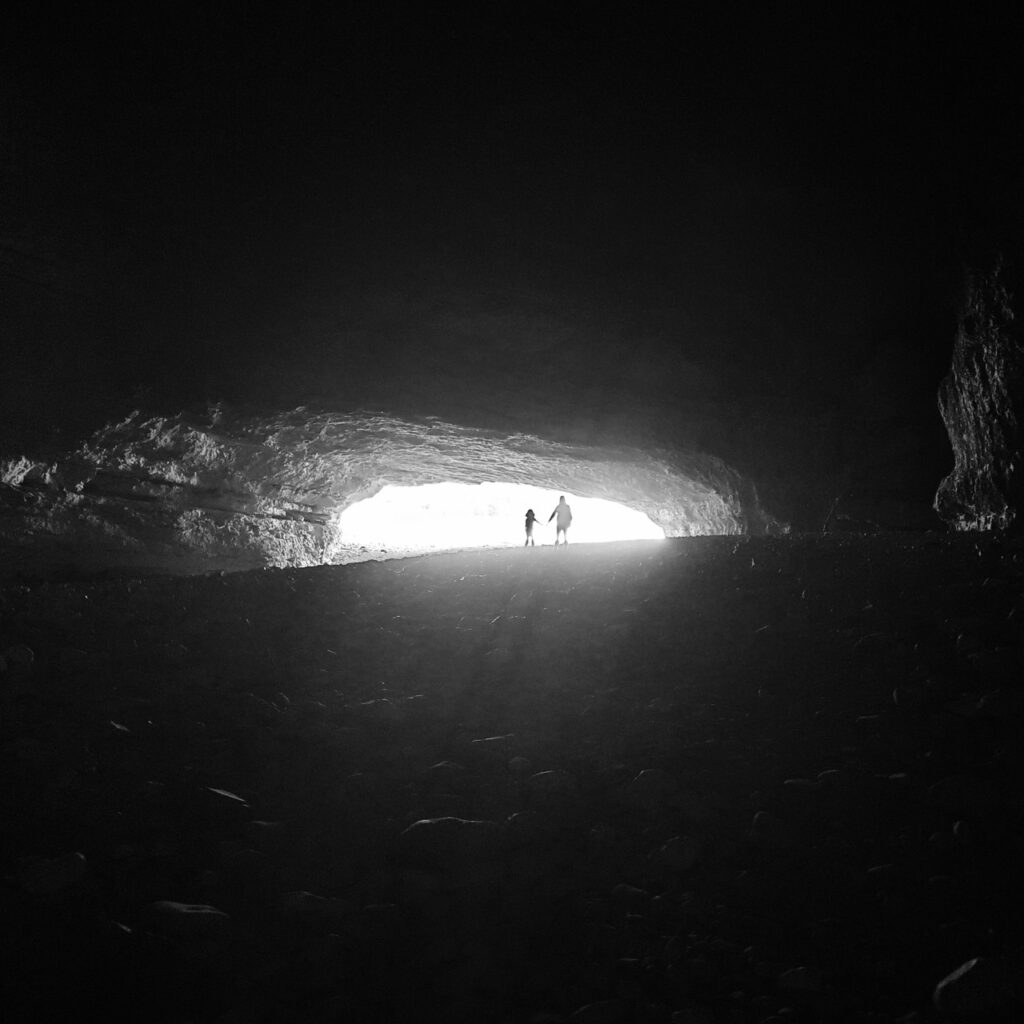
Tunnel at Minerve

While in Caunes-Minervois, Michelle and Denis suggested we visit Minerve. Denis showed us a video and we were sold. The walled village is surrounded on 3 sides by a gorge, and inside the gorge the river has carved a tunnel (the ‘Ponts Naturels‘) through the rock. Truly amazing and our photos don’t really do the village, the gorge or the tunnel justice. When we create a list of must-see hidden gems, Minerve will definitely be on it! Minerve had been a Cathar stronghold which was attacked and fell in 1210. The attackers had four trebuchets (catapults), with the largest one known as Malvoisine or “bad neighbour” which was aimed at the village’s well.

Sunset over Lac de Montbel

We had another playdate with Petra and her two daughters at Lac de Montbel, just outside Chalabre. Originally we had planned to leave the lake at 8 p.m. and drive to the aire in Castelnaudary; if all went according to plan we’d arrive minutes before the 9 p.m. curfew. Luckily, we managed to find a parking at Lac de Montbel and we decided that it was a perfect location to stay the night. This allowed us to extend the playdate and watch one of the most beautiful sunsets we had seen; the sky and the lake glowed a golden/orange colour with the snowy Pyrenees in the background. When we arrived at Castelnaudary at 2 p.m. the next day, we took the second-to-last spot. If we had arrived at nine o’clock the previous night, the aire would have been full and we would have had to drive on after curfew. In general, there are a lot more motorhomes on the road and the aires and France Passion sites are often busy; unlike October last year when we were often the only motorhome at our sites.

Petra also suggested that we see flamingos at the coast. Wait, what? But it’s true that wild flamingos are found in France. Peyriac-de-Mer was on our route so we made a detour and there they were!

It was an amazing trip to the south-east of France. We enjoyed our flexible route, with many suggestions from friends, as well as other serendipitous experiences such as showing Amelia how locks work on Canal-du-Midi, France-Passion stops with beautiful views, friendly hosts, and wonderful products (including sparkling pink Crémant and kilograms of cherries!), and stumbling upon the Aude River at Belvédère du Diable (Belvianes-et-Cavirac) where Amelia played for hours.

There were a couple of ‘learning’ experiences too. Like many other things in France, many petrol (gas) stations are fermé (closed) on Sundays; while you can still self-serve petrol this means that there is no GPL (propane) available. We suffered without our morning tea and coffee!

Never cut corners when the turn is between two buildings on an extremely narrow road – we almost got wedged! It didn’t help that the elderly homeowners were trying to tell us in French that we needed to reverse (how?) and that our motorhome was too big and didn’t belong there (too late!). Our wheels were up on the side of the road and our roof was tilting toward the buildings but luckily we had a few centimetres to spare and we managed to escape without a scratch.

Beware passing trucks on narrow roads – we stopped on the verge to allow a truck to pass but it still scraped the side of the motorhome. Fortunately, the wheel nuts had plastic caps so we only ended up with the smallest of scratches.

When your GPS sends you down a narrow dirt road that doesn’t feel right, stop and back out while you can (the fox and her two cubs were cute though – and they very looked surprised to see us).

All-in-all it was good to be back in Blue Fern.

Bon voyage!

Gary, Janice and Amelia

WE’RE NOT DOING SO WELL WHEN IT COMES TO SLEEPING IN OUR MOTORHOME

We took delivery of our motorhome six months ago and have only slept in it for 6 weeks or 23% of the time!  We had thought that we would ‘slow travel’ at times but hadn’t planned on starting so soon!  And we have spent 50% of the last year living under lockdowns in Cayman, France and Portugal.   

After spending Christmas in France with our neighbours, we got our second set of Covid tests and crossed into Portugal via Spain. We have spent the last 2½ months in the Algarve and while Portugal locked down a few days after we arrived (and is still in a partial lockdown) the goals of letting Amelia spend time with other children while attending a forest school and finding warmer weather for outside activities have been achieved.  Portugal had one of the coldest and wettest winters in recent times but January and February were still warmer and sunnier than France.

With cafés and restaurants closed and the requirement to stay home unless for essential reasons, we feel like we haven’t got to know Portugal like we experienced France. Our Airbnb hosts are a retired couple from Sweden and, at times, it feels like we have learnt more about Sweden than we have of Portugal.  We have been introduced to Swedish “fika” which is a coffee and cake break with friends; you cannot fika by yourself and it can be a verb, as in “let’s fika”. Fika has become a part of our daily routine, though we must admit to often switching the coffee and cake to Portuguese wine, beer, and cheese. Amelia has made friends with the owners’ dogs and can give all their commands in Swedish as they play their favourite games, like searching for their ball.  

Amelia_at_the_beach

You are allowed to leave your property to exercise so we have taken the opportunity to visit various beaches; either as a family or just the two of us while Amelia was at school.  We’ve enjoyed the rugged coastline of cliffs interspersed by anything from tiny coves to long sandy beaches.  The cliffs are made from soft rocks meaning the erosion is extensive; we’ve lost count of the number of arches and tunnels we’ve seen!  In Portugal the tidal range is about three metres while we are used to less than half a metre in the Caribbean.  We have been surprised how the coastline changes during our visits to the beach; Amelia can play in a tunnel one day and the next time (or even later during the same visit) it is submerged. 

While staying in one place from winter into spring, we have seen almond trees go from bare branches to full of flowers within days (the leaves come later).  Then the trees start buzzing with bees. The bees collect so much pollen you can see the full pollen sacs (or baskets) on their hind legs.  We saw a mongoose cross the road to the property (Egyptian Mongooses are found in Spain and Portugal and might have been introduced by the Romans some 2,000 years ago) and our new trail camera caught a fox trotting down the same road. Even the orange trees (of which there are lots here in the Algarve) surprised us; some trees still have this season’s fruit but are already blossoming or even growing next season’s oranges!  It seems strange to have two seasons’ worth of fruit on the same tree at the same time.

Startrails

Gary has had time to experiment with his photography again.  In 2010 he bought an intervalometer shutter release which he hadn’t really used.  However, during the last two new moons he used it to take many photos of the night sky which were later stacked to create star trails.  The next challenge is to shoot a star trail with the motorhome in the frame. 

Of course, we have also been playing and homeschooling. Amelia has been making good progress with her studies and has enjoyed some fun online classes from outschool.com. We have also used doyogawithme.com for great online yoga classes – currently offered free for two months due to Covid.

So, we’ve kept ourselves busy.  Just not sitting at the local, street café sipping coffee and eating bifanas or piri piri frango (chicken). We did however discover some online cooking classes, including a Spanish tortilla class and a Portuguese tapas class, and we have had some Portuguese takeaway recommended by Amelia’s teachers.

Now our time in Portugal is coming to an end and we look forward to heading back to France. Hopefully, the next 6 months will bring more motorhome travel and not our fourth lockdown!

Our practical guide to France motorhome travel – before the 2nd lockdown

These are our notes on motorhome travel in France in September and October 2020, before the second national lockdown. Currently, recreational travel is banned – see here for updates.

Where we stayed:

France-Passion: we stayed primarily at France-Passion sites – over 2,000 farms, vineyards, etc. that allow you to park for free in exchange for looking at their products if they have anything for sale – there is no obligation but we never walked away empty handed. We bought red, white and rose wine, champagne, grape and apple juice, goat cheese, pasta, gingerbread, jam, eggs, and vegetables. All the sites we tried were open and welcoming: www.france-passion.com. An annual subscription is €30.

Aires: these are free or paid parking areas provided by the towns and cities. They often include wastewater dumping, blackwater dumping, paid electricity, freshwater, and sometimes bathrooms. We found them through the Park4Night app (can be used offline after subscribing and downloading a regional map). All of the aires we visited were open for parking, but a few had services shut off for the winter, especially high in the French Alps. We did not stay at motorway aires; they are not generally recommended for staying the night but do have services (gasoline/petrol, blackwater dumping, picnic tables, restaurants, etc.).

Wild Camping: wild camping is legal in France (with some conditions and limitations) but with a big motorhome and a small child we didn’t want to risk having to move in the night, so we were cautious in selecting a spot. We found it difficult to be sure that we would feel comfortable with a site based only on online reviews but if we found a site that looked good we used Park4Night to check if there were any reviews for the area (for example, one of our favourite sites was a quiet stretch of road on the banks of the Rhine, where we wild camped for two nights at what was originally planned to be a lunch spot; it looked like it would be OK to stay and we confirmed on Park4Night that other people had stayed without any problems).

Campsites: these range from 1-4 stars depending on the facilities available and can also be found on Park4night. We stayed in a few campsites at the beginning of our trip and then stopped using them when we had figured other solutions for internet, laundry, and dumping waste. Many campsites close for winter.

Water/Electricity/Dumping:

Water and electricity are available on some France-Passion sites (indicated in the guidebook). Otherwise we used Park4Night to find aires – often stopping en route to a France-Passion site rather than staying the night if they had paid parking or were busy.

Driving:

Our most essential navigation tip for motorhomes is to set your GPS for the size of your vehicle – so you are not directed toward low tunnels, weak bridges, or very narrow village roads. Unfortunately, this is not possible in Google Maps. Our inbuilt motorhome GPS has this feature but stopped working during the trip so we switched to the CoPilot app. The app works offline on a cell phone and we have found it mostly reliable though it has directed us toward a few small streets; if something doesn’t look right, we do not follow it. We see fewer problems when we use the ‘easiest route’ rather than ‘fastest route’ setting. We used Google Maps to find bakeries, grocery stores, etc. and downloaded offline maps of each region so we can use it without an internet connection.

Priorité à droite: The French highway code states that a when two drivers approach an intersection from different roads, the driver on the left is required to yield, unless directed otherwise by signage. This means that a driver pulling onto a road from the right could have right-of-way. In practice, there seem to be signs overruling priorité à droite almost everywhere  – but we have seen some villages where it is in place. This article from The Local explains it quite well.

Tolls (Péage): it has always been possible for us to pay tolls by credit card however it can be expensive – one 7km tunnel cost us 17 euros! (based on the size of the vehicle). We mostly set our GPS to avoid toll roads and we have seen some beautiful country and villages (and also some terrifying narrow village streets and one-lane roads).

General:

Laundry: we have some heavy clothes like jeans and for much of our trip it was too rainy for air drying. We struggled to find places with washers and dryers other than campsites until we noticed the washers and dryers which are available in the parking lots of many grocery stores. These can be found on this website (search “a proximite” – nearby – and be sure to find a “laverie” – not a photobooth).

Shopping: large chain grocery stores tend to be located on the outskirts of towns and cities and have parking lots large enough for our motorhome. We have found most of the staples we need (sometimes only after googling “what is X called in France” or “where can I buy X in France” (e.g. baking powder is called levure chimique or levure alsacienne, peanut butter is usually in the organic (bio) aisle). The stores often have a petrol station.

The best food we bought came from France-Passion sites, speciality stores (e.g. bread – boulangerie, pastries – patisserie, cheese – fromagerie, goat cheese – chèvrerie, etc.) and local markets. Market days can be searched for on this site (select “chercher un marché” (search for a market) “autour de moi” (around me).

Grocery stores have some housewares and we also visited Ikea when stocking our motorhome.

Money: we make all of our payments using a Revolut card. Revolt is an online bank and will do currency conversions at the Interbank rate.  You get a virtual card (that you can link to Google Pay out your Apple Wallet) for free and can pay for a physical card. You can fund your Revolt account by charging your current credit or debit card.

LPG: our heater and stove run on LPG gas (called GPL in France). We also used gas designated as GPLc with no problems. Sites supplying LPG can be found on:  www.mylpg.eu Update (January 2021): We filled our LPG tank in October when France uses a ‘summer mix’ (with a higher percentage of butane). Once the lockdown in France ended and we started using the motorhome again the heater would register a ‘low gas’ error even though the tank was almost full. Only once we got to the Algarve and the temperature was warmer did the heater work again. I subsequently learnt that France switches to a ‘winter mix’ on 1 November which contains a much higher percentage of propane. So beware, you can’t use butane when the temperature falls! Details of the different mixes found in the various countries can be found here.

Internet: We purchased a sim card from a provider called Free and use it in a mifi device (which provides wifi for our motorhome). For €13 per month, the Free sim gives us 80 GB per month in France (and 10 GB per month while roaming). We purchased the sim from a kiosk (bourne) inside a tobacconist shop. You will need to put an address in France. From what we understand, there is no contract but we have not yet cancelled.  

Translations: we use Google Translate and downloaded the French dictionary so we can use it offline. The camera mode (point it at text to translate) has also been very helpful.  If you are connected to the internet, Google Translate can perform a real-time voice/dictation translation. Update May 2021: DeepL – is much better at high quality translations

Covid: We used https://reopen.europa.eu/ for information on requirements for crossing borders and this site to search for places offering covid tests in France (in case we needed to get tested before crossing a border). We use The Local for French news in English.

Attractions:  we explored Burgundy, the French Alps, Alsace, and many areas in between. We visited many farms and vineyards via France-Passion and we also enjoyed visiting some of the villages designated as the most beautiful villages in France (“Les Plus Beaux Villages de France”). They might be crowded in a normal year, but this year, and during the off-season they have been perfect. We have also – by chance – found ourselves following some driving routes such as the “Route du Grande Alpes” – there are many of these routes promoted by local tourist offices. Information on walking/hiking paths can be found on www.sentiers-en-france.eu.

Our adventure has started!

We have hit the road in our own motorhome and, two weeks later, are starting to find our rhythm. Let the fun begin!

A de-cluttered and clean apartment

Earlier in the year, we had started clearing our closets and had believed that we whittled down our belongings to a manageable level.  Boy, were we wrong!  When it came to the last week and time to move out of the apartment, we discovered we still had so much stuff.  A final round of ruthless ‘culling’ and we ended up with a manageable pile of clothes, educational material and Amelia’s toys to pack.  In the end we consolidated our lives into five checked bags!  We need to thank Jim and Sammy for helping ready the apartment, Janice’s family for letting us stay with them and for looking after Amelia while we were busy tidying the apartment and to our friends who helped in numerous ways!

What would an adventure be without challenges?  The first ‘incident’ happened after we had checked-in for our flight to London and were about to meet friends and family for farewells at George Town Yacht Club (a restaurant 3 minutes from the airport).  We were told that as this was a repatriation flight (it wasn’t) we could not leave the airport.  Amelia burst into tears.  Thanks to Janice’s perseverance (and Amelia’s distress) the duty manager made an exception and we were able to say our goodbyes!

The flights (to Heathrow and to Paris) were uneventful; it was just a long day of travelling.  Needless to say, we slept well that first night in France.  

We based ourselves in Sens (approximately 1 ½ hours south of Paris) as we had a day to spare before collecting the motorhome.  Sens is well-known for its gothic cathedral which we managed to miss in December even though we had walked within 100 metres of the cathedral (I’m putting it down to jet-lag, being tired and the cold weather)!  This time we didn’t miss the cathedral!  When Amelia saw the square in front of the cathedral, complete with pigeons, she commented that this city must have been based on the cities in Guatemala as they are made the same way!

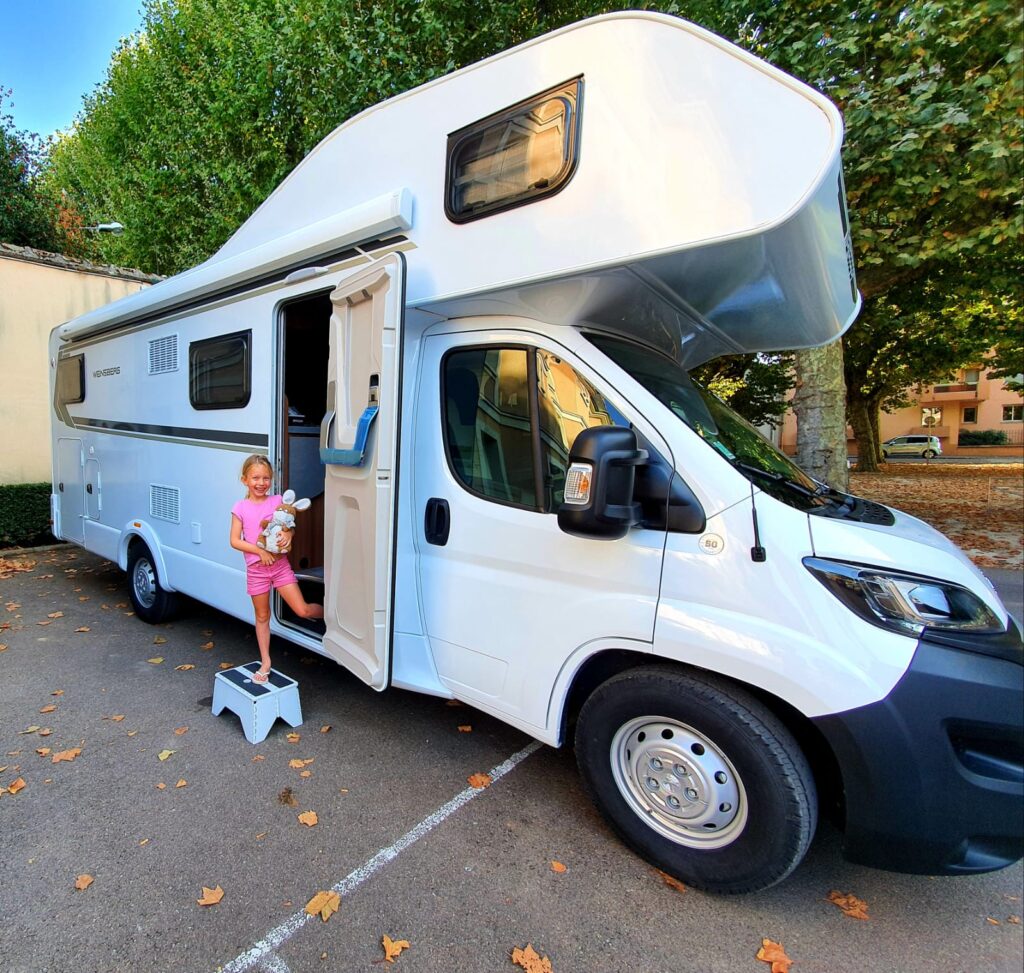
And then the big day arrived, Monday, 22 September 2020!  She looked (and is!) a lot bigger than expected (the upside is that there is that we haven’t used all the storage space … yet).  We had planned an ‘easy’ day (collect the motorhome, drive back to the hotel and unpack) and it worked out well.  If we had tried to do more, we would have run out of time and most probably had more than our two incidents.  Prior to our departure, it had been confirmed that all the vehicle registration paperwork was complete but something felt amiss as I had not been asked to pay the insurance premium.  It turns out, due to a backlog with the French authorities, the motorhome has not been registered in our names.  We are driving on temporary licence plates.  The downside is that sometime in the next month when the registration is complete, we need to return to the dealership to get our licence plates fitted.  Luckily, we have time to bimble around France!  And the other incident was when we were driving back to the hotel, I got too close to a bush and hit the passenger-side mirror.  The impact cracked the plastic casing of the mirror (luckily not the mirror itself)!  My first drive and look what I did!  A little epoxy repaired the damage.

The first brand new vehicle any of us have owned

It took about two days to unpack everything and buy the essentials which at the time seemed like a long time (I mean we have a country to explore). But, in hindsight, two days to set up a completely new, albeit small, house is quite reasonable.

There have been a few pleasant surprises.  The GPS has a function that allows you to set the size of the motorhome so no more going around a corner and finding a bridge that is too low for us to go under (yes, it happened).  And, I can control the air heater from my phone; very useful in the mornings especially after the three days of gorgeous weather ended.

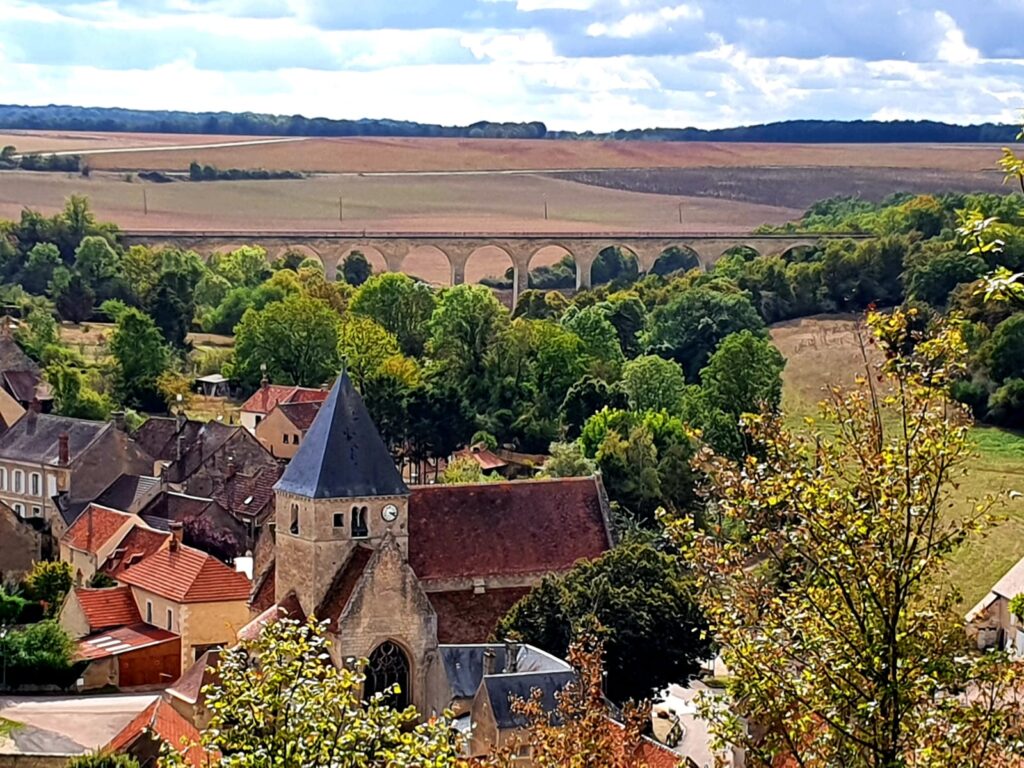
One of the many picturesque towns along our route

We are generally heading south and have been enjoying the open fields interspersed with quaint, picturesque old villages.  The motorhome is living up to expectations as were we able to spend 3 nights without any hookups before the fresh water tank runs low and the grey & black tanks become full. We have been making use of our France-Passion membership; farmers, artisans, etc. who give you a place to park and in return you are expected to say Bonjour and consider buying something they produce.  Highlights are that we’ve camped next to a field of ostriches and bought some farm-fresh vegetables but now that we are in wine country it might start getting expensive!

Until next time, au revoir!